

We’ve all seen the marketing: the glossy brochures, the noble non-profit branding, the promises of revolutionary care. For a long time, I believed it. I poured days and nights into meticulous presentations, running on empty, desperate to just be heard by the brilliant, evolved minds at the top. I thought if I could just prove my intelligence, we could fix the cracks.
But the system isn't broken; it's just a cold, transactional marketplace operating exactly as intended.
The illusion shattered for me at minute 25 of a 30-minute meeting. An executive looked at me, completely unmoved by the hours of effort in front of her, just waiting to check a box. With a performance straight out of The Devil Wears Prada, she casually brushed the hair off her cheek, peered past the cheap rhinestones on her sunglasses, and offered a smirk that confirmed the quiet part out loud: Yep. It’s just a business. Then she stood up and walked off camera.
Welcome to the Record.
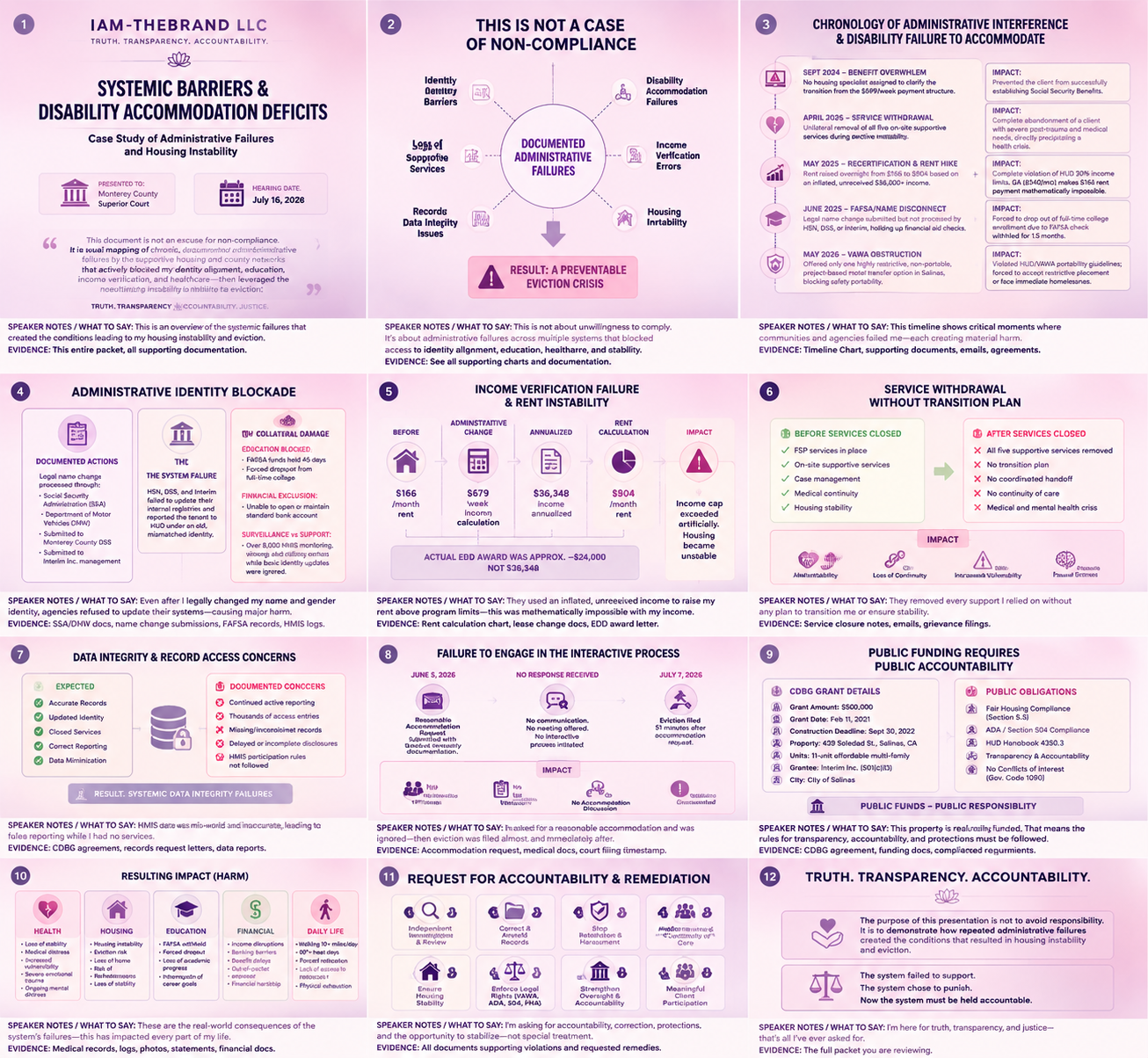
The Funding Flow: Who Controls the Money?
Nonprofits do not operate in a vacuum. Their funding is a chain of custody where each link relies on the next. If you break one link, the whole chain rattles.
The Federal & State Level
(The "Goldmines")
HUD (U.S. Dept. of Housing and Urban Development): They provide the base federal funding.
DHCS (CA Department of Health Care Services): They fund mental health programs through initiatives like the No Place Like Home program (which funded Sun Rose).
The Rule: These agencies do not monitor day-to-day operations. They rely entirely on a database called HMIS (Homeless Management Information System). If a nonprofit reports that a bed is occupied and services are being provided, the federal government keeps sending checks.
The Local Level (The Decision Makers & Distribution Hub)
This is where the actual cash is handed out in Monterey County. These are the entities they pitch to, and these are the people who are legally responsible for making sure that money is spent ethically:
The Coalition of Homeless Services Providers (CHSP): This is the local Continuum of Care (CoC). They coordinate all homeless funding for Monterey and San Benito Counties.
Monterey County Board of Supervisors: They vote on and approve the massive behavioral health contracts that fund the supportive services.
Salinas City Council: They provide local grants and land-use approvals (and, as you pointed out, they are the ones who have to step in with emergency bailouts when budgets run over).
2. Who Are the Biggest Providers? (The Inner Circle)
In Monterey County, a small circle of executives and organizations hold almost all of the housing and service contracts. They sit on each other's boards, coordinate their messaging, and present a unified, highly polished front to the public.
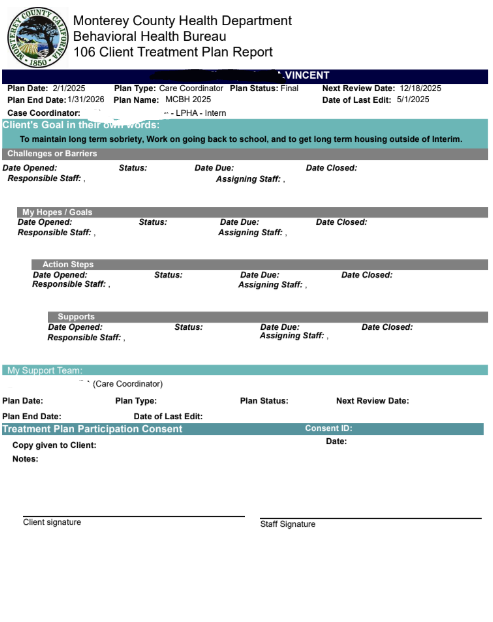
(Above is my actual final treatment plan from MCBH and their number 1 contractor of Specialty Mental Health Services. The only thing I redacted was the provider's name. This was the "plan" from my team in my Permanent Supportive Housing Full Partnership.)
The "PR Spin" and How They Protect Their Image
These organizations spend thousands of dollars on annual reports, ribbon-cutting ceremonies, and marketing. Their image is their most valuable asset because funders do not donate to failure.
To protect their image, they use a specific playbook:
The "Success Rate" Illusion: They report "95% housing retention rates." What they don't tell the public is that if they evict someone or strip their services, they can code it in HMIS in a way that doesn't count against their "success" metrics.
Shifting the Blame to "Symptomology": If a client complains about losing services or being evicted, the nonprofit’s default PR defense is to quietly imply the client is "non-compliant" or "struggling with their mental health." They use their clinical status as a shield to dismiss complaints.
Bureaucratic Silence: If a resident speaks out, the nonprofit will rarely engage publicly. They will hide behind "tenant privacy laws" (HIPAA) to avoid answering tough questions from the media, saying, "We cannot comment on specific resident cases due to privacy regulations."