

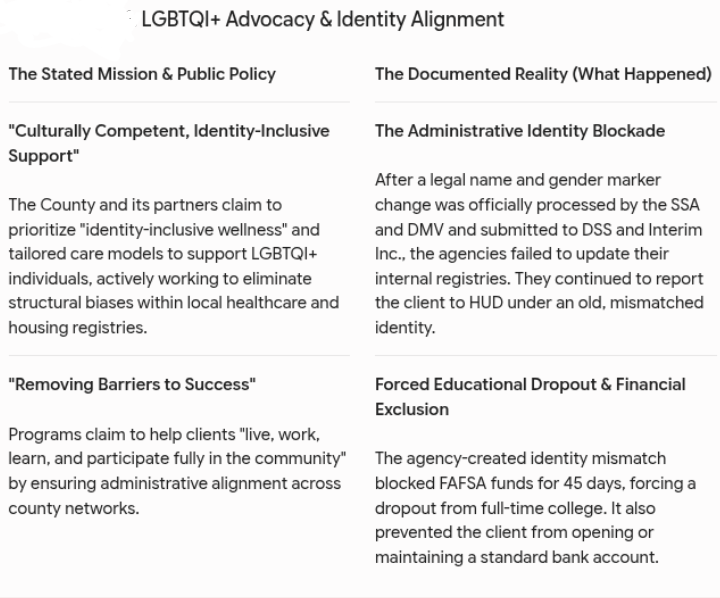
"Inclusive Care" Claim vs. Your Identity Blockade/The "Crisis System" Claim vs. Your Service Withdrawal/The "Vulnerable Demographics" Claim vs. Your VAWA Obstruction
There is a massive, painful gap between the high-level language used in agency brochures and the actual, boots-on-the-ground reality experienced by individuals. While the leadership team—including Director of Monterey County Behavioral Health and partners —publicly champion these values, your documented evidence tells a completely different story:
The "Inclusive Care" Claim vs. Your Identity Blockade: The county claims to support "identity-inclusive" services and LGBTQI+ populations. Yet, when you legally changed your name and gender marker, county networks (DSS, HSN, and Interim) completely failed to update their internal registries. This administrative failure locked you out of FAFSA funding, forced you to drop out of college, and blocked you from opening a bank account.
The "Crisis System" Claim vs. Your Service Withdrawal: The Bureau promotes robust "crisis and behavioral health access" and transitional support. But in April 2025, they unilaterally withdrew all five of your on-site supportive services during active housing instability, offering zero transition plan and directly triggering a major medical crisis.
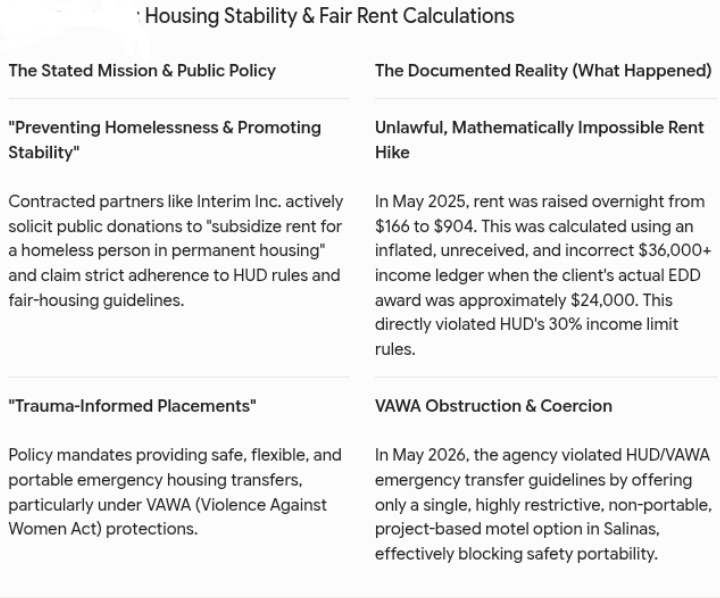
The "Vulnerable Demographics" Claim vs. Your VAWA Obstruction: Programs designed to support vulnerable populations completely failed to protect you. Instead of honoring HUD/VAWA emergency transfer guidelines, you were given a highly restrictive, non-portable placement option in Salinas or faced immediate homelessness.
Fair Housing & VAWA Violations (Civil Rights Division & HUD)
The Violation: Misclassifying a victim as a "witness" to evade safety accommodations, and continuing eviction proceedings despite pending Violence Against Women Act (VAWA) and medical relocation requests.
Actionable Framework: Under 34 U.S.C. § 12491 (VAWA housing protections) and the Fair Housing Act, housing providers receiving federal funds are strictly prohibited from evicting individuals based on acts of domestic violence, dating violence, sexual assault, or stalking.
Evidence Required for Counsel:
The original written VAWA protection request.
The written "misclassification" response or internal communications identifying you as a "witness".
Evidence of the housing provider's federal funding (e.g., HUD Continuum of Care [CoC] or PSH funds).
Americans with Disabilities Act (ADA) / Section 504 Violations
The Violation: A three-month delay in acting on a treating physician’s medical-necessity relocation request, denying programmatic transportation, and the 504 Coordinator actively breaching confidentiality by relaying grievance information to program leadership rather than resolving the issue.
Actionable Framework: Under Section 504 of the Rehabilitation Act of 1973 and Title II of the ADA, recipients of federal financial assistance must provide reasonable accommodations in a timely manner. Delays of several months without interactive dialogue constitute a constructive denial of accommodations.
Evidence Required for Counsel:
The signed physician letter documenting the medical necessity for relocation.
Log of dates/times showing the 90-day delay.
Written proof of the 504 Coordinator's conflict of interest or communication with program leadership.
Healthcare Fraud & False Claims Act (Medi-Cal & DHCS)
The Violation: Nurse Practitioner Janyce Berg and Interim billing Medi-Cal for medication support, clinical assessments, and case management services that were never performed (verified by the complete lack of prescribed medications and a full year with zero supportive services).
Actionable Framework: This constitutes a direct violation of the Federal False Claims Act (31 U.S.C. §§ 3729-3733) and California's False Claims Act. Billing for services not rendered is explicit healthcare fraud.
Evidence Required for Counsel:
A Medi-Cal Explanation of Benefits (EOB) or billing ledger showing dates NP Janyce Berg billed for medication support.
Corresponding medical records from those dates showing no prescriptions, clinical visits, or assessments took place.
Personal Narrative and Impact Statement
By June 4, 2026
It’s crazy to think I’ve been back in Monterey for five years now. It turned out completely different from what I envisioned when I decided to move home. After living in the city for 18 years, I came back to spend the end of my 30s and the beginning of my 40s with my mom—my favorite person in the world. I was ready for the party to be over. I was ready to leave the drugs and alcohol behind, settle down, and just find somewhere normal, safe, and healthy.
I had no idea my mom was going to pass away while I was here. When she died, the few people I had left turned on me. I was completely broken and at my absolute lowest when I entered Genesis House.
What happened to me after that didn't happen in a vacuum. It’s deeply tied to a long history of generational trauma in my family. I grew up watching my mother be abandoned by the very people and systems that were supposed to support her, and I watched my grandmother go through the exact same thing. I learned early on that these systems aren't built to protect people like us—especially queer and trans people of color. Still, with no family left, no partner, and no safety net, I held onto hope that this time would be different. I was trying to build the life, stability, and safety that my mother and grandmother were never given the chance to have.
Looking back, I’m still not entirely sure what I signed in 2020 during my first stay in rehab. I remember opening up to a counselor I trusted during a moment of deep grief, telling them how low I felt knowing my mom was dying and how I had looked for heroin hoping to overdose when she passed. I filled out a housing assessment without ever believing anything would actually come from it. I just assumed I’d fall through the cracks and stay stuck in programs for years. I was too numb to process anything beyond how broken my life felt.
So when I got the letter saying I’d been granted a brand-new, furnished apartment at Sun Rose Apartments, I thought it was a miracle. I thought I had finally done something right and was getting the chance to rebuild my life.
What I didn't understand yet was how these housing systems actually operate or how they target and manipulate specific demographics. I didn't realize they prioritize a "master list" designed for metrics rather than a fair waiting list for people who have been struggling for years. Once I moved in, I realized the unit came with major strings attached. I wasn't just being monitored like a lab rat; I was forced to "tap dance" so management could keep their performance numbers up for their funders. You're forced into an environment surrounded by people who are bitter, miserable, and ready to watch you fail, all while staff judges your every move.
It was never about community or recovery—it was always about funding, optics, numerical quotas, and their "three-year plan." I once sat across from a deputy director of a nonprofit controlling $40 million in assets—a woman pulling in tens of millions in grant money—and told her directly that I didn't even have food to eat while trying to restart my life. She just smiled, told me she had a meeting to get to, and confirmed what I had already begun to realize: this entire "mental health" apparatus is just a business.
When I eventually pulled my medical and housing records, I discovered the full extent of what they were doing behind my back. My psychiatric provider—who wasn't even licensed in California at the time because she had transferred under temporary COVID waivers from Colorado—had written false and damaging entries in my chart without my knowledge. She claimed I was actively using heroin and selling drugs. I never disclosed that to her, I was never assessed for it, and I was never offered substance use treatment for it.
Those entries weren't made for my clinical care. They were written as part of a preemptive narrative to shield the organization from liability. They knew I had caught onto their operational misconduct, and they realized it was far easier to write me off as having an uncooperative personality disorder than to address their own systemic failures. When I formally removed myself from their supportive services, they engaged in gutter-level retaliation: they lowered my assessment scores, altered my records, and stripped away my support systems so I would no longer qualify for assistance.
This same leadership listened to me report a severe incident of sexual misconduct involving a contracted staff member who came into my home after connecting with me on a dating app. I disclosed this violation to my psychiatric provider while sitting in her office in tears. She didn't report it, she didn't document it, and she didn't offer me a shred of support—a direct breach of her duty as a mandated reporter. She was the first person I told, and she did nothing.
When I tried to file a formal grievance, the matter was buried by the 504 coordinator—a former deputy director of 18 years currently serving as the special mental health manager overseeing the nursing program.
They didn't care about the safety violation or the harm done to me. They were already working on a plan to evict me before the incident even happened, so my grievance was just an inconvenient bump in their timeline. They retaliated by hiking my rent, altering my lease agreement classifications, and using my withdrawal from case management as an excuse to cut off all basic residential help. They went so far as to threaten staff members with disciplinary action if they helped me with basic needs, including using the office phone.
When I brought these issues to the Quality Improvement department at the County Health Department—the entity legally tasked with oversight—they minimized the claims and swept them under the rug. Licensed clinicians and administrators weaponized services against me: if you don't play along with their system, they don't care if you starve, lose your shelter, or get violated by their staff. They used my tenancy as an incubator to "work the bugs out" of their operational model before launching it broader, and discarded me when I demanded accountability.
The harm inflicted by this program didn't end when these incidents happened; it physically altered my daily functioning, my body, and my health. The continuous trauma directly impacted my nervous system, and I developed physical symptoms I never had before entering this program—including tics, body rocking, hyper-awareness, and repetitive self-soothing behaviors. These aren't drug-related symptoms; they are documented physical trauma responses caused by years of living under continuous threat, instability, and betrayal.
My nervous system has been stuck in survival mode for two straight years. I had no choice but to work 18-hour days compiling contracts, auditing ledgers, and documenting every interaction because I had zero administrative support or legal advocacy. I pushed my body past total exhaustion just to prevent an unlawful eviction and force this organization to confront the truth. Carrying the weight of betrayal from the very people assigned to protect my safety reinforced the deepest generational patterns of abandonment I spent my life trying to escape, leaving me completely isolated to navigate trauma, legal threats, and retaliation entirely on my own.
If I could go back, I would give a stark warning to anyone dealing with mental health challenges or housing instability: think very hard about what you are signing away when you enter these managed programs.At least for me this isn't care—it’s a trap designed for institutional self-preservation.
If you have anyone outside of this system you can rely on, mend those ties before you let these organizations pull you in.
Despite the intense effort to retaliate against me, misrepresent my character, and erase my record, I am still here. I am putting this on the record because I deserve to have the reality of my experience formally acknowledged. I deserve safety, stability, and care, and the institutions responsible for this harm must be held accountable.